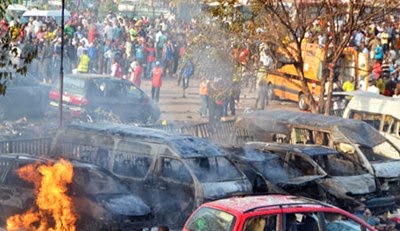
One recent afternoon in London, Simon Kolawole encounters Member Feese, survivor of the UN House Bombing who has, remarkably, decided to leverage her adversity to advocate for change in Nigeria
Tragedy is no comedy, but with Miss Member Feese, you can never tell. Here is someone who lost her leg in the August 26, 2011 attack on the United Nations House in Abuja. But a few weeks later after recovering from coma, with her left leg amputated, she sieved the heap of her birthday presents and asked: “How come nobody gave me a pair of shoes?” Laughter engulfed the room.
The bomb shattered her leg but not her will or sense of humour. She is a very strong lady. You don’t have to extort a joke or a smile from her. It comes naturally.
Asked if she had an out-of-body experience in those 30 days when she was unconscious, she jokes: “Not yet.”
“I was brought up to be strong,” says Member (pronounced mem-bay), whose name, no wonder, means “I’m happy” in the Tiv language. She’s a happy lady, forget the circumstances.
The attack, claimed by Jama’atu Ahlis Sunna Lidda’awati Wal-Jihad (better known by its street name of Boko Haram), led to the deaths of dozens and to injuries to scores. Member cannot recall anything. Nothing whatsoever. Except that she was at the reception of the UN House, waiting to be called up to use the library of the United Nations Development Programme (UNDP) for her Master’s dissertation. That is all.
“All I know is that I woke up in a hospital sometime in September,” she reveals. She can’t even remember that her car was at the UN House park, her phones switched off, her anxious family members and friends unable to locate her in the aftermath of the bloodbath.
Member can’t even remember she was admitted at the Intensive Care Unit of the National Hospital, Abuja, where an aunt located her much later.
So we need to fill in the gap for her. Actually, after the blast occurred, the victims were rushed to the National Hospital. The hospital, theoretically, is the topmost and most modern medical facility owned by the Federal Republic of Nigeria. Practically, though, there were no disinfectants, as simple as that, when the victims of the blast were admitted.
If there were no disinfectants, then imagine the more difficult things—like a power cable for the CT Scan machine. There was a machine quite all right but there was no cable. Member had to be moved to Aso Clinic for an MRI scan. The National Hospital didn’t have one (or maybe it was not working; perhaps some rat had bitten off a few centimetres from the cable, because rats play at the wards through the night).
What’s more? Oxygen had to be manually pumped; there were no ventilators. Member could have died. The constant motion of the pumping compressed her lungs further. There was no good ambulance on standby.
Unconscious, with injuries all over her body and a badly damaged leg, Member should count herself lucky that the UN flew her out of the country for further medical attention. She ended up in the UK where she was given 7 percent chance of survival on arrival and where she underwent several surgeries (“Honestly, I can’t remember how many,” she says).
But there is something she can remember vividly—that the National Hospital is not how a hospital should be, not to talk of a national one. So she and her friends have set up an advocacy group, Team Member, to highlight management failures in service delivery in Nigeria. The place to start from—naturally—is the National Hospital.
“We chose the National Hospital because it affected us closely. We are now at the stage of collating data on National Hospital from people’s bad experiences. We want to gather the evidence and go to the head of National Hospital, present it to him and ask if we could come back in a month or two to check if progress has been made,” she explains.
Fortunately, there is a job waiting for her at the Central Bank of Nigeria (CBN)—where she did her national service before going for her Master’s in the UK. After her therapies in the London, she’ll head for Abuja to take up the job offer in October.
She can afford a broad smile despite the carnage. Not just because she’s been fortunate to survive and has enjoyed so much love and care from the family but also because, after all, her will is unbreakable.
Below find the inspiring thoughts of this remarkable and resilient young lady who has opted to move from adversity to advocacy, and without bitterness:
‘We Founded Team Member to Tackle Poor Service Delivery’
Team Member is an advocacy group. We are trying to fight for better service delivery in Nigeria, like what my family and friends experienced at the National Hospital [when I was admitted after the blast]. We noticed little management failures, like the equipment not working. They send staff to buy things like pampers and disinfectants. That is why we set up the advocacy group. We are starting by focusing on the National Hospital but we plan to go to the private sector. We chose the National Hospital because it affected us closely. We officially launched the group in April during my thanksgiving. We are now at the stage of collating data on National Hospital from people’s bad experiences. We want to gather the evidence and go to the head of National Hospital, present it to him and ask if we could come back in a month or two to check if progress has been made.
‘I Have No Recollections of What Happened to Me’
I don’t have any recollections of the explosion at the UN House and my experience at the National Hospital, except the stories I that have heard, the stories my family and friends have told me, that is all… They started the stories as a joke. At 11 o’clock, the hospital shuts down and little rats start running around. They were operating on somebody and after the bomb blast, they left the person on the table and started attending to the UN House bomb blast victims. I was unconscious when I got there. I can’t remember anything that happened until like end of September, a month after. I was doing my dissertation. I am doing a Master’s in Poverty and Development at the University of Sussex so I went to the UN building to collect data. I had an appointment with somebody. I was at the reception when the blast occurred. I think I remembered up till like a week before the blast. I didn’t remember going into the UN building.
‘No Out-of-body Experience’
People normally tell us that when they were unconscious, they had an out-of-body body experience, that they were somewhere and the angels told them to go back. I’ve not had any of that yet. My brothers keep on asking me: what were you seeing?
‘I’ve Had Countless Operations’
Fortunately, most of the operations, I was unconscious and it was only one that I was conscious of. That was in October. Most times when I woke up, there would be like 50 people around me, although only two people are allowed in the ward, but trust Nigerians to always find a way… My family and friends have constantly been beside me. They move with me to every hospital so I think the experience has not been as people would think. The love and friendship around me has been fantastic.
‘Government Must Talk with Boko Haram’
I think government should try to dialogue with Boko Haram. I don’t think government has reached out to them to find out what their problem is or what they want. They should have a dialogue with them first so that they can find out what their main concern is and what they want from the government. I think the first thing is dialogue and may be if the government speaks to them, they would stop: fighting violence with violence is never the answer; it will only result in more casualties.
‘I’m Not Bitter, No’
No. I am not bitter and I think people would expect me to be angry with them but anger is not the solution. I am just grateful to God for sparing my life. In all this, my philosophy of life has changed and I am seeing life in a new light now. I try to live everyday as my last day. I feel as if God has given me a second chance on life. That is why we started the advocacy group and we are trying not to allow anybody go through what I went through. We see it as if God has given a second chance to tell our story and reduce the casualties in Nigeria.
‘My School Gave Me Extra Time’
Like I said, I was doing my Master’s Programme in Poverty and Development at the Institute of Development Studies, University of Sussex. After the incident, they extended the deadline for my dissertation and gave me an extra year till September 2012. I’ve already been discharged from the hospital. The specialists come to the house every week for follow-up, therapy, neuro-psychology.
‘Treatment is Costing a Fortune’
It is costing a fortune receiving private medical treatment in the UK. That is what we are fighting for. When I came here, nobody at the Nigerian High Commission or government spoke to us. The Nigerian High Commissioner to the UK does even know we are here. Even people that came from NEMA (the National Emergency Management Agency) came 36 days after the incident. We had to pay for the treatment by ourselves. I think the government has partly reimbursed us. But I’m getting better. I had a stroke too. My right hand was weak. But it is getting better gradually. We went to a centre last week, a place for amputees, and the guy said he has had 150,000 Nigerian patients, all amputees. Another thing we are pushing: in Nigeria, you cannot find a system or society for amputees. We were told the number was 150,000 from Nigeria alone, many from car accidents.
‘I’ve Not Lost My Sense of Humour’
On my first birthday after I had been amputated as a result of the injuries I sustained in the blast, I went through the gifts and joked: how come nobody gave me shoes? People say I am a strong girl. I don’t know where I got it from. I’m religious. I am a Catholic. I have always been very religious.
‘Nigerians Must Fight for Change’
I want to appeal to Nigerians to join our cause and stand up for change even if they don’t have personal experiences. God forbid, one day you may have a personal experience. Even the hospitals are not well equipped for treatment of ailments like malaria and typhoid. We are trying to appeal to everybody to join our cause and if you have any bad experience at the National Hospital or any other place, send us a message. We are trying to get as much proof as we can get to show the Head of the National Hospital or the Minister of Health that this is what the people are experiencing. In Nigeria, people say ‘I will manage’ and managing has not led to anything. It has only got us so far. We want anybody that has a bad experience to join our cause and speak up because if we don’t speak up, things will become worse and God forbid, our grandchildren will not even have a country.
‘I’m into Advocacy to Fight Frustration in the Land’
I always felt that my friends and I were meant to represent the supposed fortunate 1% of Nigerians who got good local and international education. I thought we were meant to be part of a meaningful system by now - driving growth and development for a rejuvenated Nigeria. However, my over 50 friends (most of them with 2:1 and 1st class degrees) are still searching for jobs or are unhappy with the ones they have had to settle for in Nigeria. We often discuss how our country is one where there is no voice for the ‘small man’ and no accountability for the ‘big man’. These frustrations have resulted in a need to carry on the cause for advocacy using the efficient team of friends and family that fought for my life when there was no in-built system to rely on.
I had always taken an interest in development. My MA dissertation research is on the lack of social protection in Nigeria. Through this experience, my friends and I will build an even bigger system in order to extend our help to all Nigerians. Team Member is an issue-based group that raises issues and identifies solutions to assist the government to be better. We are not fighting anyone in particular, (we are) merely demanding a better Nigeria for us to live in. Having witnessed first-hand that we can solve problems with new-age ideas that are not even in circulation within our parents’ generation, we wish to use these ideas to transform Nigeria. We will raise whatever issue is at the heart of the common Nigerian, and together, work towards better services especially from our leaders in the National Assembly and even from private operators such as the airlines, banks, media, etc. The National Hospital in Abuja is our first focus, beginning with easy-to-measure indicators.
My frustration is that I cannot get specialized care at home. I have to go to the UK regularly for check-up. There is no specialised service in Nigeria. I am a Nigerian citizen but the people in the UK treat me like I am a citizen of the UK. I have been discharged and all my therapists come to my flat to treat me. A physiotherapist and an occupational therapist visit me every week. Why can’t we have this back home?
Box
The Natural Advocate
MEMBER HEMBADOON FEESE
BORN October 3, 1987
SCHOOLED at Loyola Jesuit College, Abuja, Nigeria (1997-2003); Queen Anne’s School, Caversham, Reading, UK (2003-2005); University of Bath, Bath, United Kingdom (BSc Economics and International Development, 2005-2009); Institute of Development Studies, University of Sussex, UK (MA Poverty and Development, 2010-12)
WON an academic scholarship of £2000 during her 1st year at the University of Bath.
SHE was a student representative for the Economics and International Development Course and an Academic Executive at the University of Bath. Fought for changes in degree structures and assessment methods.
SHE was Secretary of the Afro-Caribbean Society for 2006/2007 academic year; liaised with the students union and organised social events for the members of the society.
SHE worked with a group of friends on ensuring the attainment of the Millennium Development Goal 6 to help combat HIV/AIDS and other diseases by building a health centre in a local village outside Abuja, Nigeria.
IN 2008, she participated in Cancer Research’s Race for Life in June 2008; raised £450 for cancer research.
IN 2002, she was a volunteer at Motherless Babies Home, Abuja, Nigeria, caring for orphans and vulnerable children.
***
For breaking news out of Abuja, follow us on Twitter: @MetropoleMag